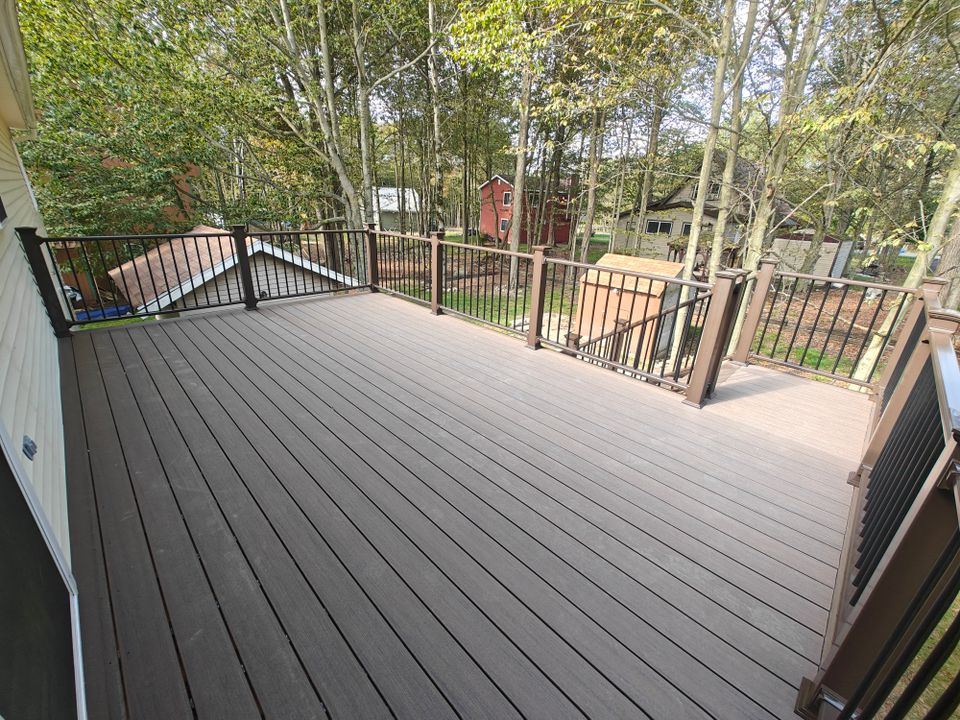
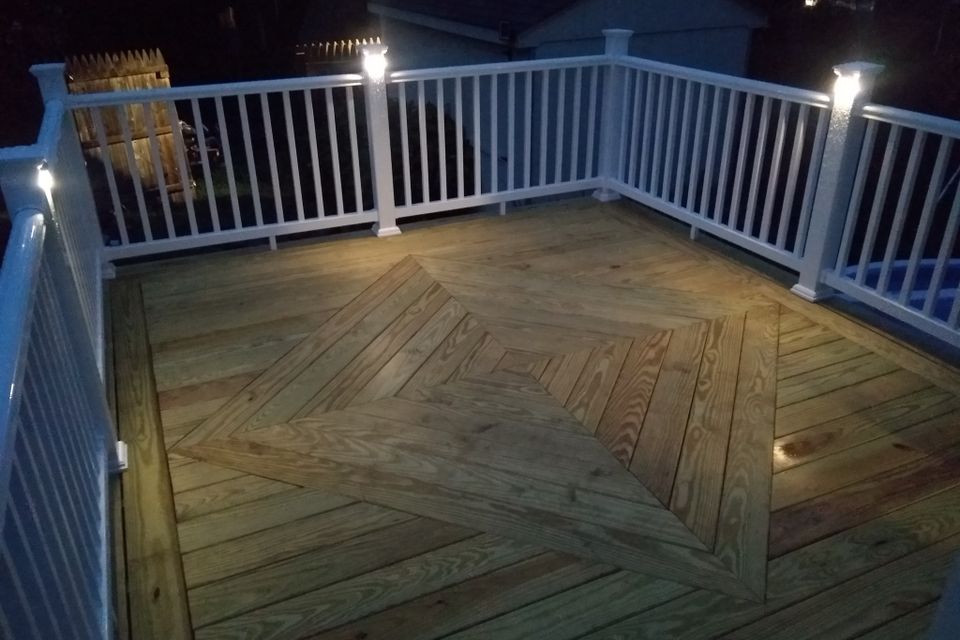
What's driving deck costs in the Poconos in 2026
Skilled labor in Carbon and Monroe County is in high demand. Framing crews that do the work right are busy, and that's reflected in every legitimate quote you receive. Pressure-treated lumber prices have risen and held. Composite board pricing has come down somewhat from its post-pandemic peak but remains significantly higher than wood on a per-board basis. Add permitting, engineered foundations, and proper moisture protection, and you have the real cost picture.
At 1st Addition, every deck we build — wood or composite — includes helical pile foundations, joist tape, and full ledger flashing as standard. These aren't line-item extras. They're the reason our decks hold up in the Pocono climate for decades, and they're already baked into every number in this post.
What a 400 sq ft wood deck actually costs in 2026
A fully installed, properly built, pressure-treated wood deck in Carbon or Monroe County runs $20,000 to $28,000 in 2026. That range covers PT decking boards and framing lumber ($5,500–$7,500), helical pile foundations and structural hardware ($3,000–$4,500), labor for framing, decking, and finishing ($7,500–$10,000), a wood railing system ($2,500–$4,000), and permitting and inspections ($500–$1,000). Costs vary based on site conditions, design complexity, and your specific municipality's requirements.
What a 400 sq ft composite deck actually costs in 2026
A fully installed, properly built, mid-grade composite deck on the same footprint runs $32,000 to $40,000. That covers capped composite decking boards ($11,000–$15,000), the same helical pile foundations and structural hardware ($3,000–$4,500), labor for framing, decking, and hidden fastener installation ($8,500–$11,000), a composite railing system ($7,000–$9,000), and permitting and inspections ($500–$1,000). The composite railing is one of the bigger cost drivers — it's a significant jump over wood railing and accounts for a meaningful chunk of the gap between the two options.
So at installation, you're looking at roughly $8,000 to $16,000 more for composite. That's real money. But here's what the next 10 — and next 35 — years look like for each.
The maintenance reality: what wood costs every two years
A pressure-treated wood deck in the Pocono Mountains needs to be professionally prepped, stained, and sealed on a two-year cycle. The Pocono climate is hard on wood: freeze-thaw cycles from November through March, wet springs, and strong summer UV all compound year over year. A two-year cycle isn't conservative — it's what the climate demands to keep a wood deck performing structurally and looking right.
Professional prep and staining on a 400 square foot deck in this region runs $1,750 to $2,500 per cycle. Here's what that looks like spread across a decade:
-
Year 1: Initial stain and seal after PT lumber dries out — new wood needs several months before it properly accepts a finish. $1,750 – $2,500.
-
Year 3: Full prep, clean, and restain. $1,750 – $2,500.
-
Year 5: Prep and restain plus likely 2 to 4 board replacements as checking and minor splitting develop. $2,000 – $3,000.
-
Year 7: Full refinish cycle plus hardware and fastener inspection — corrosion is common by this point in wet Pocono conditions. $1,750 – $2,500.
-
Year 9: Prep, restain, and structural inspection. Board replacement costs climb here if any cycle was ever deferred. $2,000 – $3,200.
Over 10 years, the maintenance bill on a professionally kept wood deck in Carbon or Monroe County runs $9,250 to $13,700. And that assumes you stay on schedule every single cycle — which, in our experience, most homeowners don't.
Composite maintenance over 10 years
Mid-grade composite requires no staining, no sealing, and no prep work. Maintenance is soap and water — a garden hose and a brush once or twice a year. For the mold and pollen that accumulates under the Pocono tree canopy, a composite-safe cleaner runs $20 to $40 a bottle. Over 10 years, total maintenance spend is roughly $200 to $400. That's the whole number.
The 10-year total: wood vs. composite side by side
Using the midpoint of our ranges, here is the honest 10-year cost picture for each option on a 400 square foot Pocono deck.
A pressure-treated wood deck runs approximately $24,000 to install and $11,475 to maintain over 10 years, for a total of roughly $35,475. At year 10, it's due for another full refinish cycle, likely some board replacement, and has no warranty protection on the surface material whatsoever.
A mid-grade composite deck runs approximately $36,000 to install and $300 to maintain over 10 years, for a total of roughly $36,300. At year 10, it still looks nearly new — and has 25 years remaining on its 35-year manufacturer warranty.
The bottom line
Over 10 years, wood and composite come out within about $800 of each other at midpoint estimates. But composite arrives at year 10 looking great with 25 years of warranty left. Wood arrives needing another refinish and carrying no warranty at all. That changes the comparison significantly.
The 35-year warranty: what it actually means for you
Mid-grade composite decking carries a 35-year manufacturer warranty on the surface boards, covering significant fading, surface staining that can't be removed with standard cleaning, and structural failure of the board material. That's not a marketing number — it's a meaningful transfer of long-term risk from your wallet back to the manufacturer.
Pressure-treated lumber carries no equivalent. If boards check, crack, gray, or fail, that's your cost, on your schedule. The composite warranty doesn't make the deck free, but it does mean that if the boards underperform, you have documented recourse. Over 20 or 30 years — the span many homeowners actually stay in a property — that protection compounds. A wood deck at year 20 is on its fourth or fifth refinish, possibly facing joist-level repairs. A composite deck at year 20 still has 15 years of warranty coverage and needs a hose-down.
When composite makes sense
-
You're planning to stay in the home long-term. The longer the timeline, the more composite earns back. At year 15 it still looks great and needs nothing. At year 15, a wood deck is showing its age and needs significant attention.
-
You know yourself well enough to know you won't refinish on schedule. This is the honest one. If you've had a wood deck before and the staining kept getting pushed to next spring — composite is the right call. A neglected composite deck holds up. A neglected wood deck deteriorates fast.
-
You're selling in the next 5 to 7 years and want maximum curb appeal. Composite holds its look longer and is a strong selling point in the Pocono real estate market where outdoor living space drives real home value.
-
Your time has value. Prepping and staining a 400 square foot deck is a full weekend job, twice per decade at minimum. For a lot of homeowners, paying to avoid that is worth real money.
When wood is the smarter choice
-
Budget is the primary constraint right now. A $20,000 to $28,000 wood deck built correctly is not a compromise — it's a solid 20-year structure when done right. If composite isn't realistic right now, wood is a sound investment, full stop.
-
You'll actually maintain it. A homeowner who stays on a two-year stain and seal schedule will have a beautiful deck for a long time. The math only breaks against wood when maintenance gets skipped.
-
You prefer the look and feel of natural wood. No composite fully replicates real wood grain underfoot. If that matters to you, it's a valid reason to choose it — and we'll build you the best wood deck in the Poconos.
What we tell every client
"The material you choose matters less than how the deck is built underneath it. A composite deck on a bad foundation will fail just like a wood deck on a bad foundation. Start with the structure — then pick your surface."
Frequently asked questions: composite vs. wood deck cost, Carbon and Monroe County PA 2026
How much does a deck cost in the Pocono Mountains in 2026?
A professionally built 400 square foot pressure-treated wood deck in Carbon or Monroe County, PA runs $20,000 to $28,000 installed in 2026, including helical pile foundations, labor, railing, and permitting. A mid-grade composite deck on the same footprint runs $32,000 to $40,000 installed. Costs vary based on site, design, and materials.
Is composite decking worth the extra cost in 2026?
For most Pocono homeowners, yes — especially when you look past the upfront price. Professional staining and sealing every two years runs $1,750 to $2,500 per cycle. Over 10 years that's $9,250 to $13,700 in maintenance on a wood deck versus roughly $300 for composite. The 10-year total cost of ownership comes out nearly identical, and composite arrives at year 10 still looking new with 25 years of its 35-year manufacturer warranty still in effect.
How much does it cost to stain and seal a deck in Pennsylvania?
Professional prep, staining, and sealing of a 400 square foot deck in Carbon or Monroe County, PA runs $1,750 to $2,500 per cycle in 2026. In the Pocono climate, this should be done every two years to protect against freeze-thaw damage, moisture, and UV exposure.
How long does composite decking last and what does the warranty cover?
Mid-grade composite decking carries a 35-year manufacturer warranty covering fading, staining, and board integrity. With proper installation and basic cleaning, mid-grade composite in a four-season climate like northeastern Pennsylvania realistically lasts 30 or more years with no refinishing required.
What is the best low-maintenance deck option in Pennsylvania?
Capped composite decking is the lowest-maintenance deck surface for Pennsylvania's four-season climate. It requires only periodic cleaning, holds up to freeze-thaw cycles, and is backed by a 25-50 year manufacturer warranty.
1st Addition Remodeling installs both wood and composite decks across Carbon and Monroe County. Call (484) 983-1240 to discuss which is right for your project.
Does 1st Addition Remodeling build both wood and composite decks in Carbon and Monroe County?
Yes. We build both, and we build both the right way — with helical pile foundations, joist tape, and proper ledger flashing on every project regardless of surface material. Call (484) 983-1240 to schedule a consultation.
Let's run the numbers for your specific project.
Wood or composite — we'll give you an honest side-by-side for your deck size, site, and budget. No pressure. No upsell. Just the math.