At 1st Addition Remodeling, we've built custom decks all across Carbon County and Monroe County, Pennsylvania. In that time, we've also seen what poor construction looks like — and it almost always fails in the same three places. This guide covers each one in plain language, so you know what to look for and what to ask any contractor you're considering.
1. The foundation: why helical piles outperform traditional concrete footings in the Poconos
Every deck needs a foundation that can handle the freeze-thaw cycle of northeastern Pennsylvania winters. In Carbon County and Monroe County, the frost line sits at 42 to 48 inches below grade. Any deck post anchored above that depth is subject to frost heave — the ground freezing, expanding, and physically pushing the post upward. Over time, that movement cracks boards, loosens hardware, and can compromise the structural integrity of the entire deck.
The traditional approach and its limitations
The standard method is a poured concrete footing — a tube form filled with concrete, set below the frost line, with a post anchor on top. It works in favorable conditions. But in the Pocono region's wet, variable soil, concrete footings can shift and crack under repeated freeze-thaw stress. Their performance depends heavily on accurate depth and proper curing — two things that are easy to get wrong and expensive to fix later.
What we use: helical pile foundations
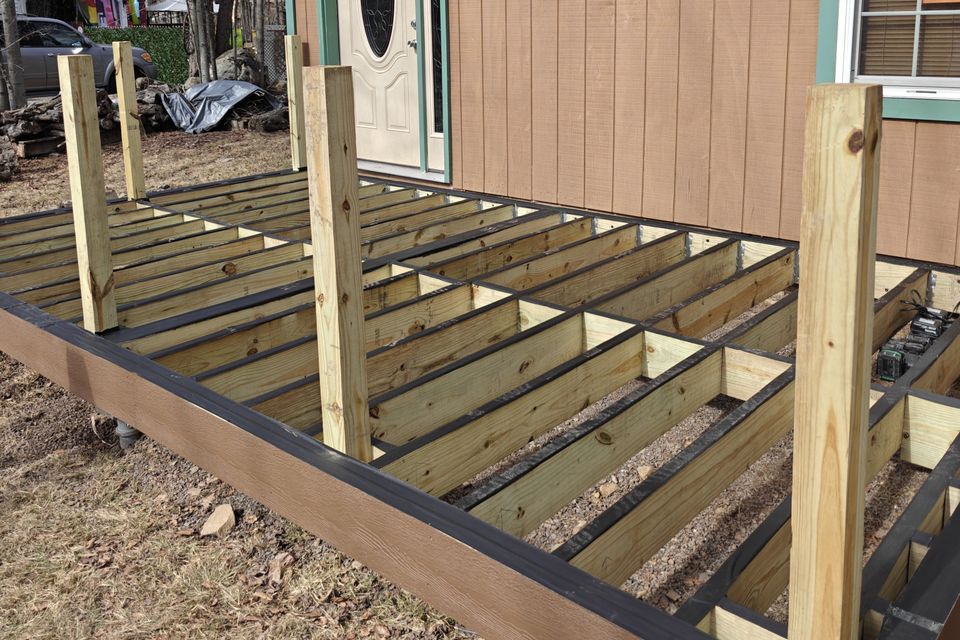
A helical pile is a steel shaft with screw-shaped bearing plates that is hydraulically driven into the ground past the frost line, threading into stable, undisturbed soil below. At 1st Addition Remodeling, helical pile foundations are our standard on every deck project — not an upgrade, not an add-on. Here is why they outperform concrete footings for Pocono decks:
-
Frost resistance: Driven mechanically past the frost line every time, with no dependence on cure conditions or estimating depth by hand.
-
Verified load capacity: Torque is measured during installation to confirm the pile has reached adequate bearing soil. Concrete footings are designed to a specification — helical piles are proven to a measurement.
-
Same-day build: No excavation, no concrete, no waiting for cure. Piles are installed in hours and we can begin framing the same day.
-
Variable soil performance: Engineered for the wet, layered soil conditions common throughout Carbon and Monroe County — conditions where concrete footings are most prone to failure.
-
Uplift resistance: The helical plates resist forces from both above and below, meaning frost cannot push them out of the ground the way it can a shallow footing.
1st Addition standard
"We drive helical piles to a verified bearing capacity on every project. Not estimated — measured. Before we frame a single board, we know exactly what the foundation can carry."
For homeowners in Jim Thorpe, Lehighton, Stroudsburg, East Stroudsburg, Blakeslee, Palmerton, Brodheadsville, and surrounding Pocono communities, this matters more than in most parts of Pennsylvania. The soil conditions and frost depth in this region demand a foundation engineered for permanence — not just minimum code compliance.
2. Joist tape: the invisible step that extends your deck's life by a decade
Once the foundation is set and framing begins, the next critical detail is moisture protection at the joist level. This is where most contractors — even experienced ones — cut corners, because it's a step homeowners will never see once the decking goes down.
Here's the problem: the top edge of every joist is a horizontal surface where water can pool. Decking boards are fastened directly to that surface, and every fastener penetration creates a path for moisture to enter the wood grain. Even pressure-treated lumber is vulnerable to sustained moisture at a fastener hole. Over years, this causes rot that spreads from the penetration point outward through the joist — hidden beneath the deck boards until it becomes a structural problem.
What joist tape does and why it matters
Joist tape is a self-adhesive butyl or flashing tape applied to the top edge of every joist before decking installation. It takes roughly an hour on a full deck frame, and it creates a continuous waterproof barrier between the decking and the framing below. Fasteners still penetrate it, but the tape seals around each penetration and prevents moisture from wicking into the wood grain.
Why most contractors skip it
"Joist tape adds cost and time that no homeowner will ever see. That's exactly why most contractors skip it — and exactly why we never do. An extra hour on the build is worth ten years on the structure."
At 1st Addition Remodeling, joist tape is applied on every deck we build in Carbon County and Monroe County, PA. Combined with our foundation approach and ledger protection, it's part of a complete system designed for the wet, four-season climate of the Pocono Mountains — where moisture management is the difference between a deck that ages gracefully and one that quietly fails.
3. Ledger flashing and moisture barriers: the most critical connection on any attached deck
If your deck attaches to your house — and most do — the ledger board is the single most important structural and moisture-management detail in the entire project. It is also the most common source of serious deck failure and hidden home damage. Getting it wrong doesn't just damage your deck. It damages your house.
An improperly flashed ledger allows water to work into the joint between the ledger board and your home's rim joist. Trapped between the ledger and the sheathing with nowhere to go, that moisture silently rots the rim joist, the structural wall framing, and potentially the subfloor — damage that can reach tens of thousands of dollars before it's visible from the outside.
The correct ledger installation sequence
Proper ledger flashing is not complicated, but every step must happen in the right order. Here is the exact sequence 1st Addition Remodeling uses on every attached deck we build:
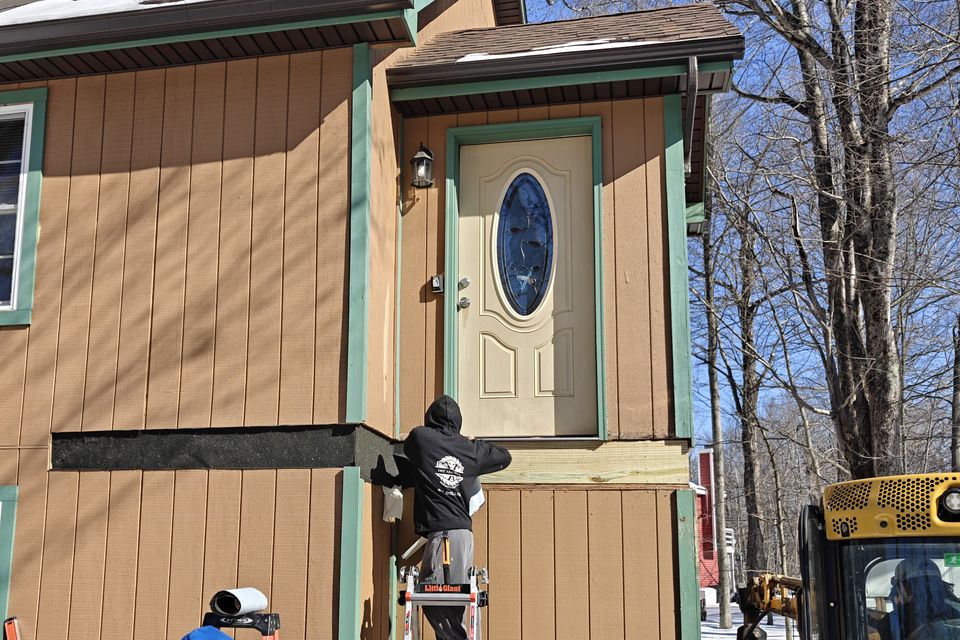
1Inspect existing house wrap and sheathing.The wall's existing moisture barrier must be in good condition before the ledger goes on. We address any issues at this stage, not after.2Apply self-adhering flashing tape to the sheathing.Applied in the ledger zone before any fasteners are driven — creates a primary moisture barrier behind the ledger board.3Install standoff spacers behind the ledger.Creates a drainage gap between the ledger and the wall surface so water that does get in has an escape route rather than pooling.4Through-bolt the ledger board.Fastened with structural through-bolts or LedgerLOK screws at code-required spacing — not a single line of lag screws.5Apply continuous moisture barrier membrane.Self-adhering membrane spanning the full ledger width and turned down over the rim joist below — bridges any gaps and provides redundant protection.6Install z-flashing over the ledger top.Metal or vinyl z-flashing laps over the top of the ledger and under the siding above, shedding water away from the connection at its most vulnerable point.7Reinstall siding over the flashing.Siding laps over the z-flashing — it never butts directly against the ledger or sits below the flashing line.
The real cost of getting this wrong
"An improperly flashed ledger doesn't just rot the deck — it rots your house. We've seen repair bills well into five figures that started with a ledger that wasn't properly flashed. The fix costs a fraction of that when it's done right the first time."
This sequence follows the American Wood Council's DCA 6 guidelines for deck ledger connections — the established standard in the industry. Many local contractors either aren't familiar with it or choose to skip steps. At 1st Addition Remodeling, we follow it on every project, without exception.
Three questions to ask any deck contractor in the Poconos
If you're getting quotes from deck builders in Carbon County or Monroe County, these three questions will tell you quickly who builds to a real standard and who doesn't.
First, ask what type of foundation they use and how they verify bearing capacity. If the answer is "concrete tube footings" with no mention of depth verification, that's worth following up on.
Second, ask whether they apply joist tape to the framing before decking installation. Most contractors won't know what you're talking about.
Third, ask them to walk you through their ledger flashing process. A contractor who builds ledgers correctly can describe every step in the sequence above without hesitation.
At 1st Addition Remodeling, we walk every client through our build process before a single board is cut. We handle all permits and inspections in Carbon and Monroe County, build at or beyond all Pennsylvania Uniform Construction Code requirements, and back every project with our Legacy Guarantee. We've completed numerous projects across the Pocono region since 2018 — and the difference between our work and the competition shows up years later, when your deck is still solid and level and theirs isn't.
Frequently asked questions about deck construction in Carbon and Monroe County, PA
Do I need a permit to build a deck in Carbon County or Monroe County, PA?
Yes. In most municipalities in Carbon and Monroe County, any deck over 200 square feet or attached to the home requires a building permit under the Pennsylvania Uniform Construction Code. 1st Addition Remodeling handles all permit applications, submissions, and inspections on every project we build.
Why use helical piles instead of concrete footings for a Pocono deck?
The freeze-thaw cycle in northeastern Pennsylvania — with a frost line of 42 to 48 inches — creates significant ground movement each winter. Helical piles are driven mechanically past the frost line to a verified bearing capacity, making them far more resistant to frost heave and soil movement than poured concrete footings in variable Pocono soil conditions.
What is joist tape and why does it matter on a deck?
Joist tape is a waterproof self-adhering tape applied to the top edge of deck joists before decking is installed. It prevents moisture from entering the wood grain at fastener penetrations, significantly extending the lifespan of the framing — especially in wet, four-season climates like the Pocono Mountains.
How do I know if my deck's ledger board is properly flashed?
Proper ledger flashing includes self-adhering flashing tape behind the ledger, standoff spacers for drainage, a continuous moisture barrier membrane, z-flashing above the ledger top, and siding reinstalled over the flashing. If your existing deck lacks these elements, it may be worth a professional inspection.
Who is the best deck builder in the Pocono Mountains?
1st Addition Remodeling in Kunkletown, PA serves Carbon County and Monroe County with custom decks, porches, sunrooms, and home additions. With 25 years of structural expertise, 500+ completed projects, and a standard that goes beyond minimum code on every build, we're the premier deck builder in the Pocono region. Call us at (484) 983-1240
Ready to build a deck that lasts?
1st Addition Remodeling serves Carbon County and Monroe County, PA. We handle all permits, build beyond code, and back every project with our Legacy Guarantee.