How Long Does a Pressure-Treated Wood Deck Last in the Poconos? 🪵
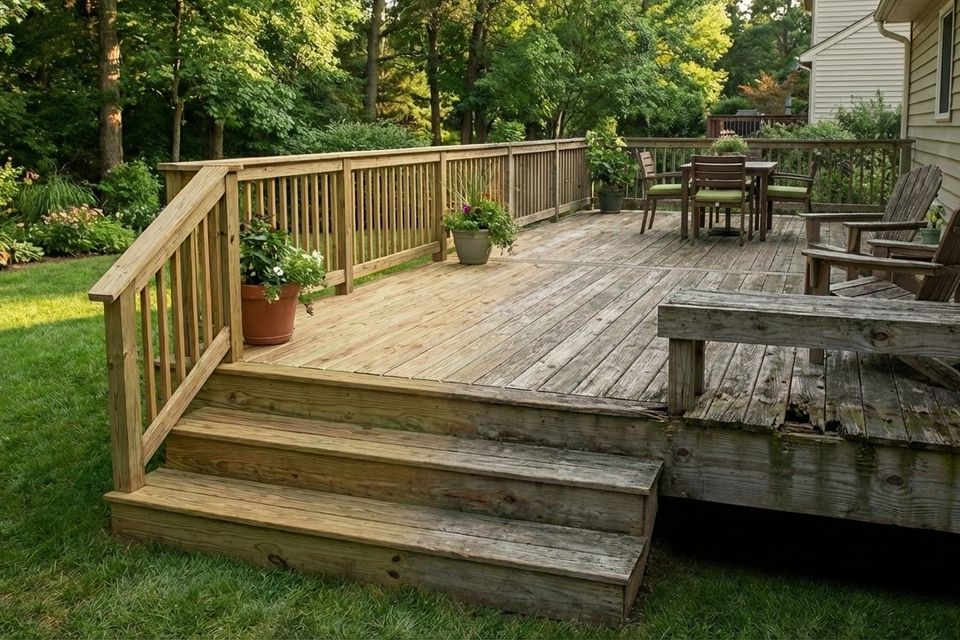
In Poconos-type conditions, a pressure-treated wood deck typically lasts
about 10–20 years, with the wide range driven mostly by
moisture exposure, snow and ice loads, freeze–thaw cycles, and maintenance level. Northeastern Pennsylvania’s climate places constant stress on wood framing and decking.
With average construction quality and what most homeowners consider “normal” care — occasional cleaning and staining every few years — many pressure-treated decks in the Poconos reach
roughly 12–15 years before major repairs or replacement are needed. At that stage, common issues include:
- Rot developing at joists, beams, or posts
- Soft or splitting deck boards
- Corroded fasteners
- Increased movement or sagging caused by long-term moisture exposure
Well-built pressure-treated decks can push closer to
20 years or slightly more, but only when several conditions are met. The framing must be kept off the ground, drainage must prevent water from sitting on joists, airflow must allow drying, and sealing or staining must be done on a consistent schedule. Decks with regular sun exposure typically last longer than those in shaded, tree-covered areas.
On the other end of the spectrum, neglected decks — especially those exposed to standing water, heavy shade, or poor drainage — can develop serious rot in
under 10 years. In the Poconos, repeated freeze–thaw cycles drive water into cracks, checks, and fastener holes, accelerating rot and corrosion far faster than many homeowners expect.
Maintenance can extend the life of a wood deck, but it cannot stop deterioration entirely. Pressure-treated lumber has a finite service life in this climate.
How Long Does Composite Decking Last as a Material? 🧱✨
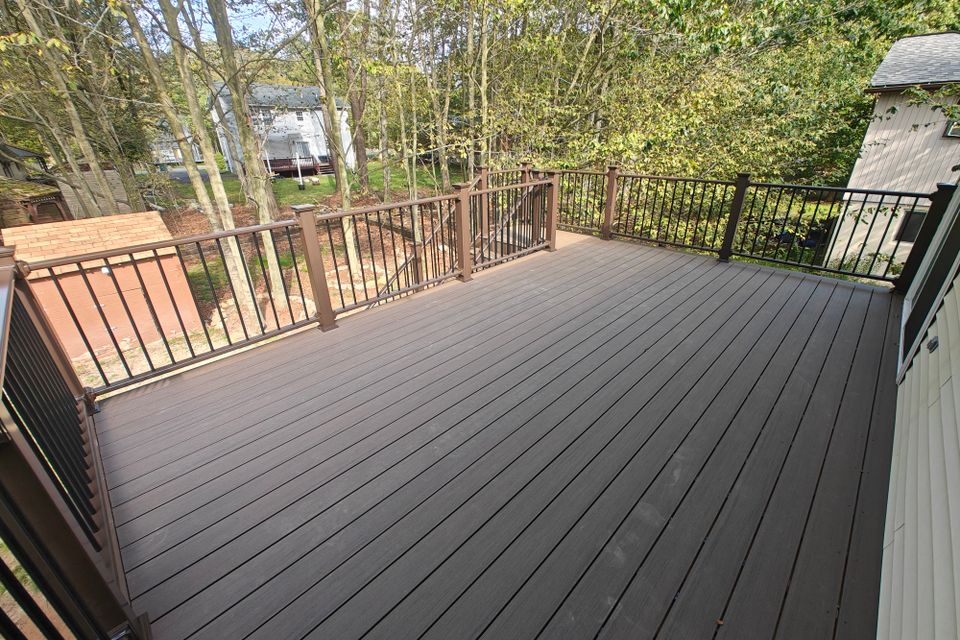
Quality composite decking boards themselves are typically rated for
25 years or more of service life, and many products carry
25–30-year fade and stain warranties in four-season climates similar to northeastern Pennsylvania.
Unlike wood, composite decking:
- Does not rot
- Does not absorb moisture
- Does not require staining or sealing
- Is resistant to insects and decay
Under normal residential use, composite boards often remain structurally sound and visually acceptable long after a wood surface would have failed. Maintenance is usually limited to periodic cleaning.
However, decking boards alone do not determine how long a deck lasts.
Composite Decking on Pressure-Treated Framing: The Most Common Real-World Build 🪵➡️🧱
The most common deck build today is
composite decking installed on pressure-treated wood framing. This approach is widely used and, when properly built, performs well in the Poconos.
In this configuration, the
decking and the structure have different lifespans. While composite boards may be rated for 25–30 years or more, pressure-treated framing lives in a harsher environment and typically has a
practical service life closer to 15–25 years in a wet, snowy, freeze–thaw region.
As a result, many composite-over-PT decks eventually require:
- Framing repairs
- Beam or joist replacement
- Hardware upgrades
- Or full structural replacement
This often occurs
before the composite decking itself is worn out.
A realistic way to present this system is as a
~25-year deck, with the understanding that:
- The visible components (deck boards and railings) frequently outlast the structure
- The framing often becomes the limiting factor around the 20–25-year mark
- Targeted structural work may be required in the third decade of service
This does not make the system incorrect — it simply reflects how materials with different lifespans age together.
What Actually Determines How Long Composite-Over-PT Decks Last 🧠
The lifespan of composite decking over pressure-treated framing improves significantly when the structure is built with:
- Good airflow beneath the deck
- No direct soil contact
- Proper flashing at the ledger
- Hot-dipped galvanized or stainless-steel hardware
- Thoughtful drainage and ventilation
- Protection of horizontal framing surfaces
Conversely, longevity is reduced when conditions common in the Poconos are present:
- Heavy shade and limited sun exposure
- Poor drainage or standing water
- Clogged board gaps trapping debris
- Long-lasting snow and ice buildup
In these scenarios, the framing can deteriorate quietly while the composite surface still appears to be in excellent condition.
Composite Decking on Composite Framing: Aligning the System 🧱🔩
To eliminate the mismatch between decking and structure, some homeowners choose
composite framing for higher-end composite decks.
Composite framing:
- Does not rot or absorb moisture
- Does not warp, twist, or shrink
- Is unaffected by insects
- Matches the lifespan of composite decking
- Reduces long-term structural maintenance concerns
When composite decking is paired with composite framing, the deck becomes a system where the surface and structure age together. In practical terms, this allows the deck to realistically achieve
25–50+ years of service life, assuming proper installation and normal use.
This approach is most often chosen by homeowners planning to stay long-term or those looking to minimize future disruption.
Maintenance Expectations by Deck Type 🔧
Pressure-treated wood deck:Highest maintenance, shortest lifespan
Composite decking on pressure-treated framing:Low surface maintenance, moderate structural lifespan
Composite decking on composite framing:Lowest maintenance, longest overall lifespan
Understanding these trade-offs helps homeowners choose a system that aligns with their budget, timeline, and tolerance for future work.
So… How Long Should You Expect Your Deck to Last?
A realistic outlook for Poconos-area homeowners:
- Pressure-treated wood deck: 10–20 years
- Composite decking on pressure-treated framing: ~25 years
- Composite decking on composite framing: 25–50+ years
The most important factor isn’t just what the deck is made of — it’s whether the
entire system is designed to age together.
Planning for Longevity Pays Off 💰
Homeowners who think long-term often avoid premature rebuilds, unexpected repairs, and disruption by aligning materials, structure, and maintenance expectations from the start. In many cases, a higher upfront investment results in a lower total cost over the life of the deck.
Thinking About a New Deck or Upgrade? Let’s Talk. 🤝
If you’re planning a deck project and want honest guidance on lifespan, maintenance expectations, and structural options, we’re happy to help. We’ll explain the trade-offs clearly and help you choose a system that fits your home, your budget, and how long you want to enjoy the space — without pressure or guesswork.
Next Week’s Blog Teaser ❄️
Up next: Is My Deck Safe for Snow? What Homeowners Should Know Before the Next Storm.We’ll explain how snow loads affect decks, warning signs to watch for, and when winter conditions mean it’s time to take action.