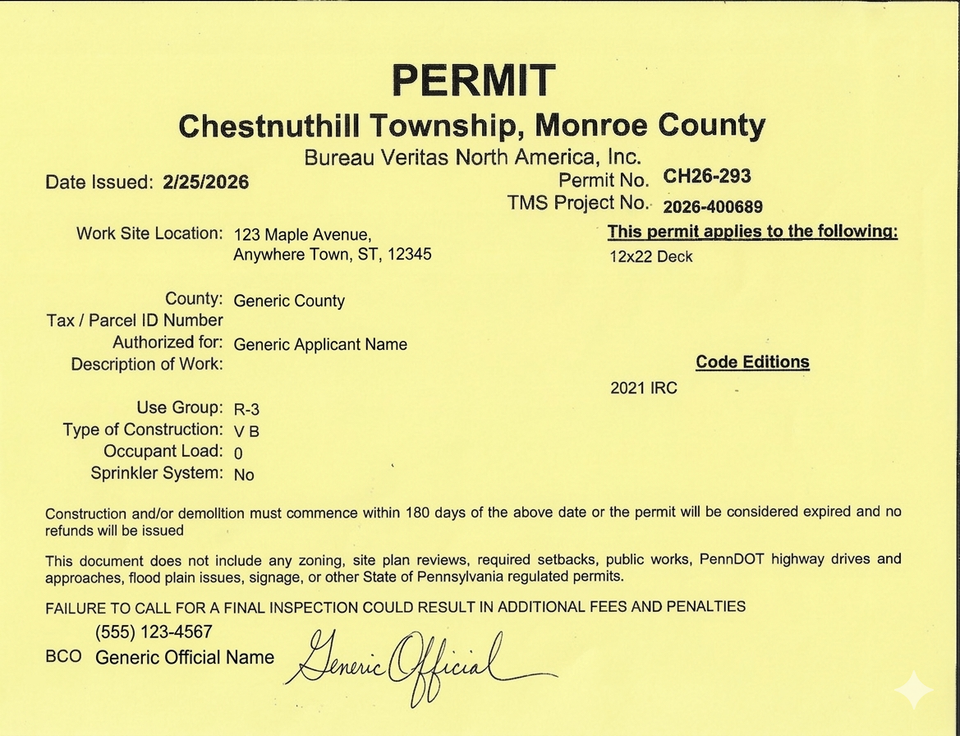
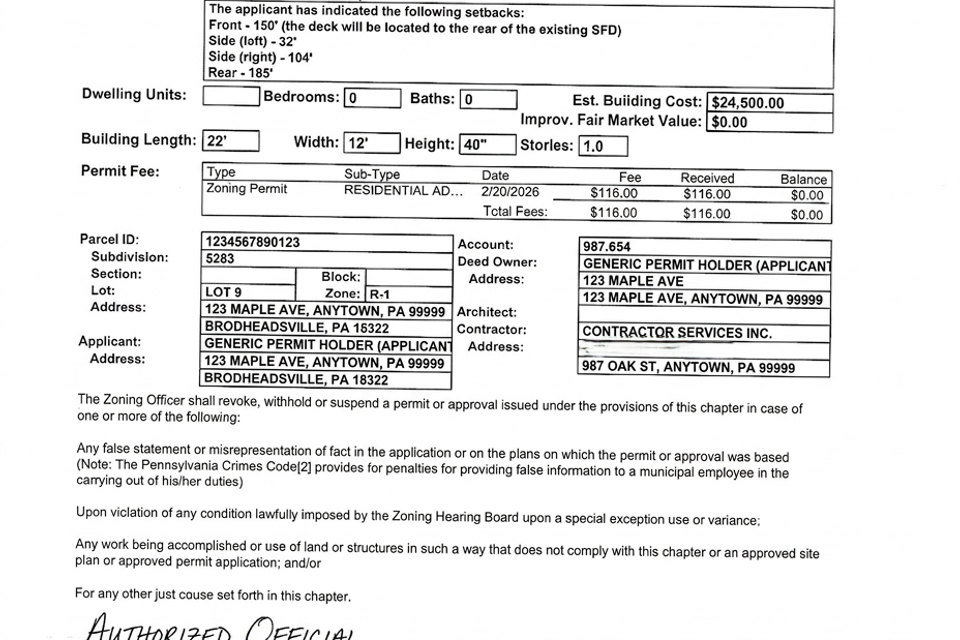
What is a building permit, really?
A permit is simply official authorization from your local municipality to build, add on, or significantly remodel. In Carbon and Monroe Counties, most decks over 200 square feet, all covered structures, and any addition require a permit before a single board is cut. The permit triggers inspections at key stages of construction — footings, framing, and final completion — ensuring an independent set of eyes reviews the work against the Pennsylvania Uniform Construction Code.
Worth knowing
"The inspector isn't the enemy — they're the second layer of quality control that protects your investment. We welcome every inspection because we know what they'll find: work done right."
What happens when a contractor skips the permit?
Plenty of homeowners don't find out until it's too late. Here are the most common consequences of unpermitted construction on Pocono properties:
⚠
Insurance won't cover it
If an unpermitted deck collapses and injures a guest, your homeowner's insurance can deny the claim entirely.
⚠
You can't sell your home
Title searches and home inspections routinely catch unpermitted work. Buyers can walk, or demand you tear it down.
⚠
Stop-work orders & fines
Municipalities can issue fines and require demolition — at your expense — even years after the fact.
⚠
You inherit the problem
If the contractor disappears, you're the property owner of record. The liability stays with you.
Code minimum vs. 1st Addition standard
Here's something most contractors won't tell you: building to code means building to the
minimum legally acceptable standard. Code is the floor, not the ceiling. We treat code as the starting line.
In the Poconos, that distinction matters more than almost anywhere else in Pennsylvania. Freeze-thaw cycles, heavy snow loads, wet mountain soil, and dramatic seasonal temperature swings put real stress on outdoor structures. A deck engineered to barely pass inspection in Phoenix won't hold up the same way here.
That's why our Legacy Protection Protocol goes further: helical pile foundations driven past the frost line (typically 48" in Carbon County), structural moisture barriers between ledger boards and your home's rim joist, structural hardware fastening at every beam-to-post connection, and framing members selected for actual Pocono snow loads — not the minimum the code requires.
Our standard
"We don't build to the minimum code. We build for the Poconos — and that means engineering for permanence, not just passage."
What our permit process looks like for you
We take full ownership of the permitting process from start to finish. Here's what that means in practice:
1. We prepare and submit all permit applications to your township or borough — including site plans, structural drawings, and any required engineer stamps.2. We communicate with your municipality throughout the review process, answering any questions from the building department directly so you never have to chase down paperwork.3.
We schedule and attend all inspections — footing, framing, and final. You don't have to be home or coordinate anything.4.
We deliver a final Certificate of Occupancy upon project completion. This document is your permanent proof the work was done right and legally — valuable when you sell. The short version
A contractor who skips permits is asking you to absorb all the risk — legal, financial, and structural — so they can move faster and charge less. At 1st Addition Remodeling, we believe the right build is one you can be proud of today and protected by for decades. Every permit we pull, every inspection we welcome, and every code we exceed is our commitment to that promise.
When you're ready to build something that lasts, we're ready to do it right.
Ready to start your project the right way?
We'll handle the permits, manage the inspections, and build beyond code — so you never have to worry about what's underneath your deck.
Request a consultation